
Three Points of the Compass carries an android mobile phone while hiking. This does everything I want it to do. This includes playing digital files, it has a radio and (fairly) decent speaker. But using it for music does eat into the battery. So, do I still carry an ‘old school’ music player on hikes?
Thankfully I no longer have to contend with my Sony Walkman in the outdoors. First introduced to the public in 1979, it was an exciting piece of kit in its time. At last, we could easily take our preferred music with us out of the home, no longer relying on radio alone. What’s more, these players were affordable to many. They were certainly popular, over 400 million were sold. But, beside the case, what about all the tapes that had to be carried along too? How many recall the hours spent making up ‘mix-tapes’ to share around? My model shown below was the Walkman FM/AM Radio Cassette Player WM-FX277, released in 2001. It operated on two AA 1.5v batteries. Some other Walkman models could operate off a thin rechargeable nickel cadmium ‘gumstick’ battery, which was a useful feature. However the dedicated chargers were big bulky affairs. The daft little headphone that came with mine have not survived the years, the thin foam covering to the ear pieces was never that robust. With batteries and a tape installed, and a simple pair of replacement ear buds, it weighed 248g without the horrible pouch that it came supplied with.
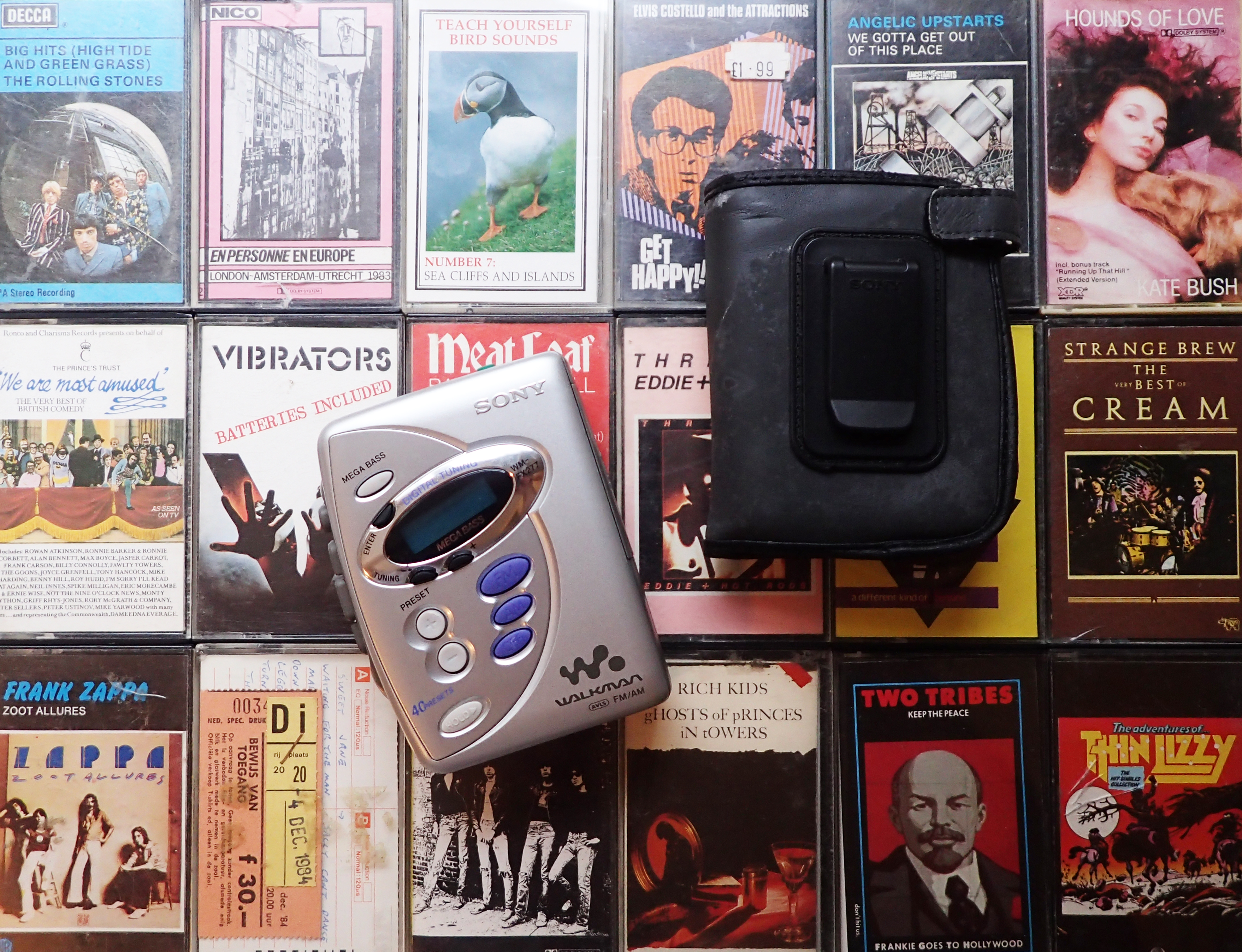
My Sony Walkman from a good few years ago. The combined tape player/radio was quite a bulky item and could not fit into a pocket. The rather horrible plastic wallet with belt clip was a necessity when walking anywhere without a pack. There were few people, myself included, that didn’t also use the rather naff clip on belt pouch. Technology had to catch up with us as none of us really liked having this thing dangling by our side, complete with its trailing headphone lead. Each tape weighed around 32g without its plastic case.
Following in the wake of my Walkman was my Discman for playing Compact Discs. Portable CD players were first invented in 1984 by Sony and they sold over 50 million of them. Sadly, my Sony Discman never survived the years. To be honest, I was never the greatest fan of it as it skated terribly if jolted, so it rarely left the house. ‘Jog-proof’ models followed but I never trusted them enough to buy one. Each CD weighed 15g outside its plastic case.
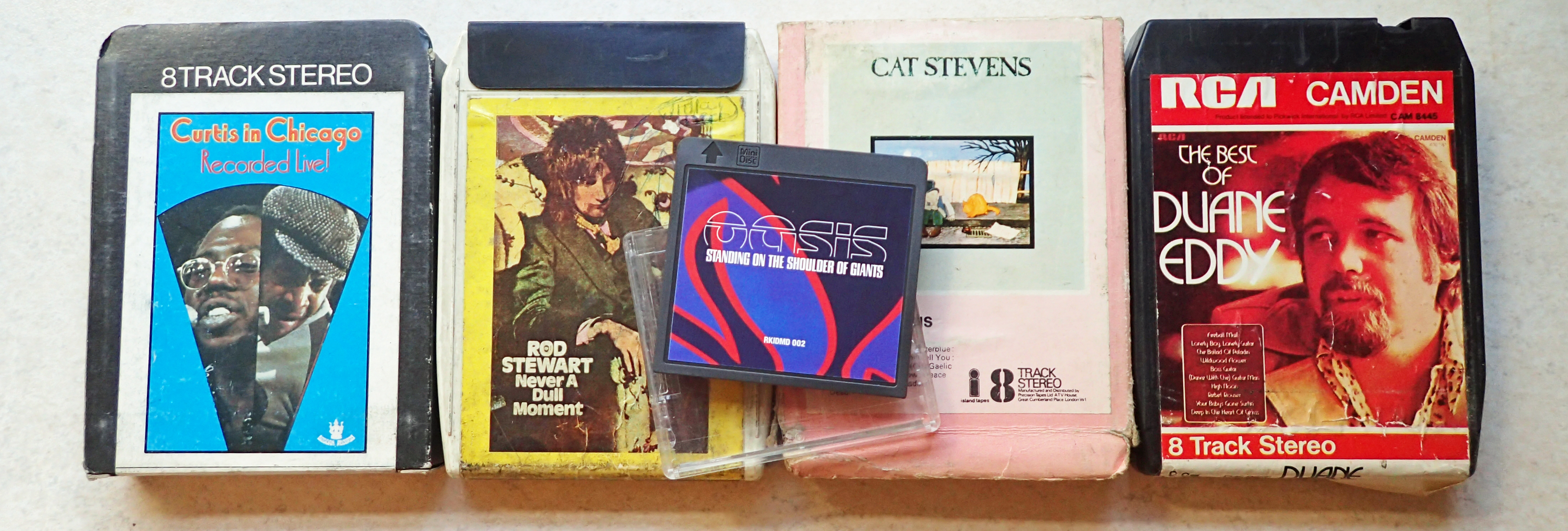
Eight track cassettes from the 1970’s (each around 121g without card sleeve), and MiniDisc- 2000 (each disc weighed 17g without plastic sleeve). Relatively few titles were available in the latter format
Sony announced the MiniDisc medium in 1991 and the first player was released just a year or two later. Digital sound quality was good, and the storage space on each disc superior to the CDs that came before with up to 80 minutes. An interesting mix of magneto and optical technology. The pre-recorded discs, such as my Oasis disc above, were purely optical. However, it wasn’t to be- Sony and technology generally, and the public specifically, gave up on MiniDisc players after just a few years. Sony ceased manufacture in 2013. A shame really, as my next big step in ‘music on trail’ saw not only a marked improvement in player memory, size and convenience, but also a drop in sound quality, though I suppose we have all come to accept this these days without question.

The Sony MiniDisc Recorder MZ-B10 operated off two AA batteries (or mains power) and had a built microphone and speakers. Released in 2003, it had 48 hour battery life on playback. it was possible to change the recording mode and get as much as 320 minutes with an 80 minute recordable MiniDisc. Weight, with player, handstrap, two batteries, earbuds with integrated control switch and MiniDisc installed, was 248g
I was pleased when the next step-change in portable music came along. This was mp3, standing for MPEG Audio Layer III. Invented in the early 1990s, the music format became very popular later in that decade and I somewhat reluctantly fell in step with it. The World’s first commercially released personal digital mp3 player was the MP Man F10, released in March 1998, it had a 32MB memory and held around eight songs. By the time I purchased my MP Man MP-Ki (MP-FUB26) in, I think, 2004, it held, as the manufacturers put it, an “awe-inspiring” 128MB. At last, I was able to transfer more than just a few of my vinyl collection to digital files and take the music out with me. The little player, played for well over a day on one tiny AAA battery, could be plugged straight into my PCs USB outlet, no messing about with leads necessary. My little MP Man player weighed 58g with a 1.5v AAA battery installed, including a set of 17g buds.
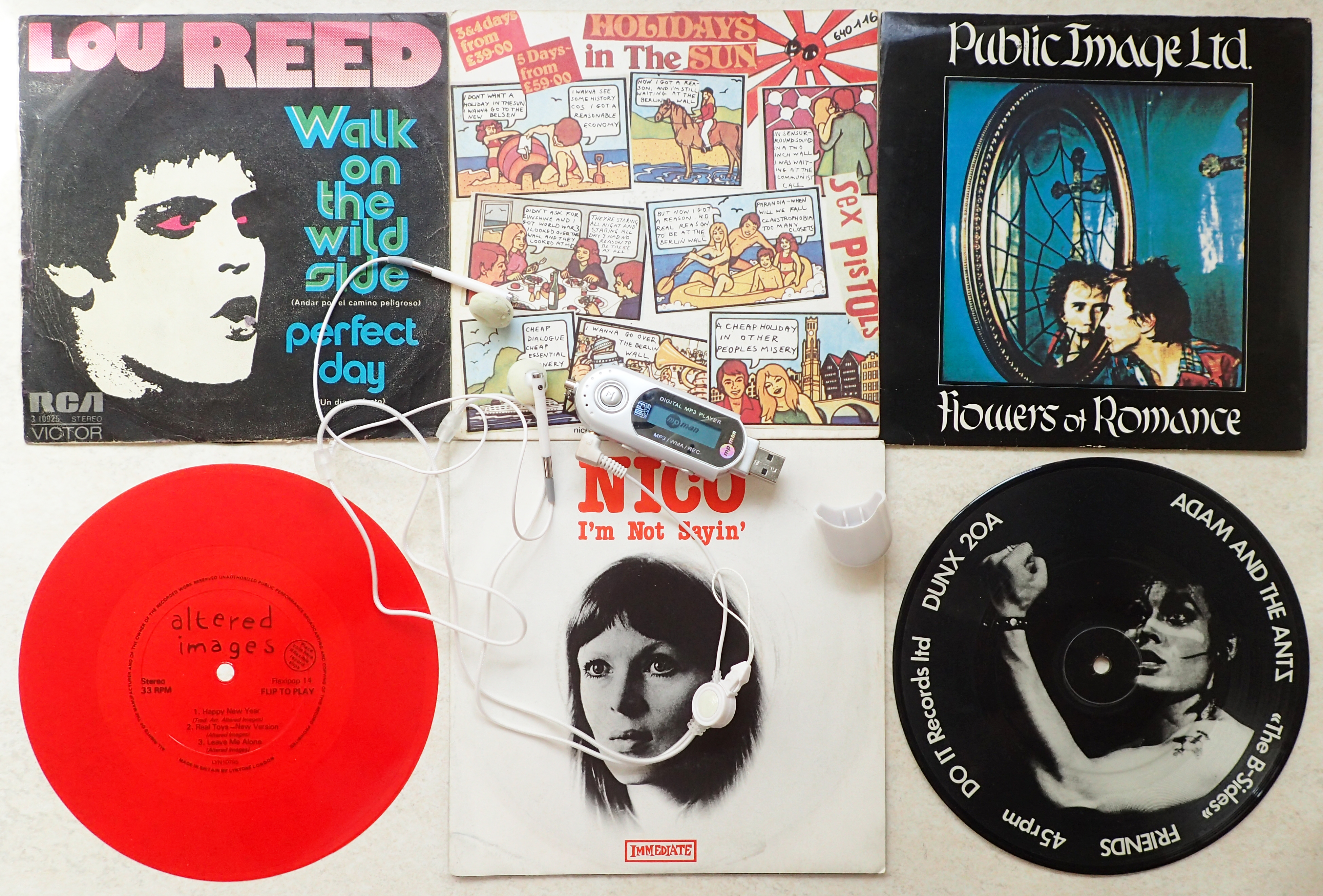
My one surviving early mp3 player- the little MP-Ki 128 from MP Man. Despite having a dire memory, this was actually a pretty good piece of kit, running, seemingly for ever, off of a single AAA battery. Once the end cap was removed, it could be plugged directly into a computer.

6th generation iPod Classic
When Apple turned up they seemed to take over the mp3 market almost overnight despite there being many audio file formats. The first iPod was released in October 2001 but I waited a few years before dipping a toe into their merchandise as they were a tad pricey compared to what else was around, and I never had a lot of money back then. My first iPod was the Classic. That had an ‘immense’ 160GB memory but was a chunky, quite heavy piece of kit (140g). But in my large hands, I found the ‘click wheel’ easy to use. Introduced in 2007, they were finally put to bed in 2014. My Classic just died a death one day, the battery finally succumbing to age. So, real value for money there…
I moved on to a 7th generation Apple iPod Nano with 2.5″ multi-touch screen and 16 GB flash memory. This, in theory at least, gave me storage for up to 4000 music tracks and I had it stuffed with a few seventies concept albums and various podcasts was quite a bit under that number. But still, on a full charge, the battery supposedly had almost 30 hours of playback, though I reckon I actually got far less than that. On the tiny screen there is also 720 x 576 video playback (3.5 hours of playback on a full charge) and I occasionally uploaded a film or two to watch, but again, that ate into the memory. Though much larger than a 12.5g iPod Shuffle, this really was a tiny little player. However a Shuffle has no screen and is more awkward in track selection. Much of the iPod Nano’s 31.5g weight (with no buds) is down to a metal body construction.

My iPod Nano weighed 45g including 14g ear buds. This is my model A1446 from 2012. The buds are not Apple, I tended to go through these and used just about anything more reasonably priced that I could afford to lose or have damaged. Usually my replacements were Sony or JVC. There was Bluetooth capability on the Nano but I didn’t use this due to its effect on battery life
Of all the iPods, I reckon this generation Nano was the most functional that I owned. The Shuffle is diminutive, but only had 2GB storage. Other Apple models also had too many negative features to my mind. Plus, I liked the little screen on the Nano and didn’t have toooooo many issues with being a slave to iTunes. I could almost endure the drop in sound quality that we now all have to accept, almost…

The FM Radio on the Nano always worked well for me and I tended to use this feature most frequently while commuting, though it did require wired buds to work. I never used the integrated pedometer as I don’t believe in the accuracy of these.
Mp3 devices are now obsolete, replaced by the phone for all other than nostalgic diehards. The mp3 music format was officially declared defunct by it’s creators in 2017. Apple discontinued production of the Nano and every other mp3 player they produced, though the iPod Touch was still available until the autumn of 2017.
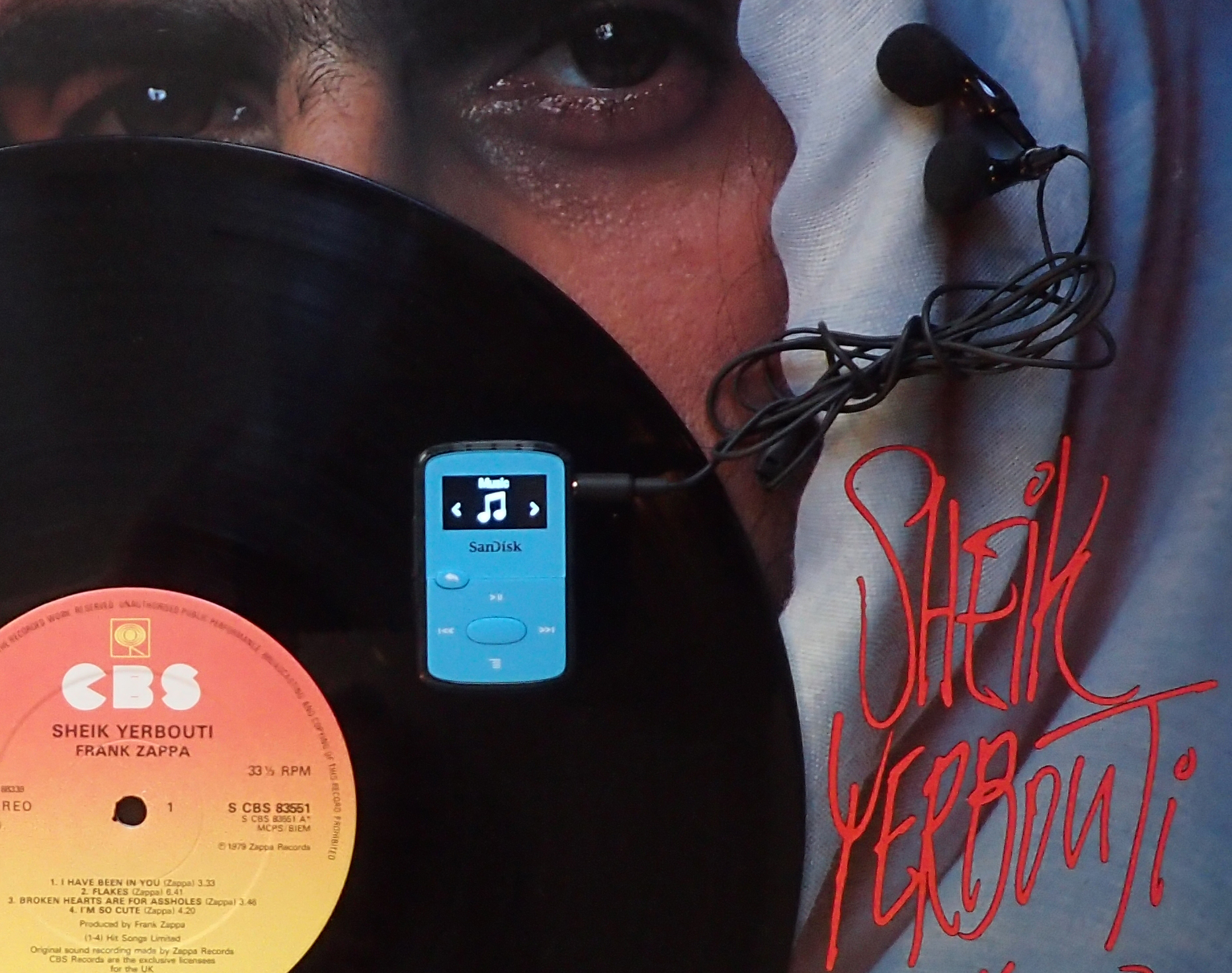
The minuscule SanDisk Clip Jam is made of plastic and came with a clip on its reverse. FM Radio could also be played, provided ear buds were fitted to act as an aerial
For a few years on trail I stepped away from Apple products with the little SanDisk Clip Jam. This diminutive player had a plastic body and only weighed 23.3g without buds, plus another 11g for the SanDisk buds or 14g for my Sony/JVC earbuds. So it normally weighed less than 38g and could be charged with a USB/Micro USB cable I already had with me for charging other devices. It could not sync with iTunes but could be plugged into my PC via USB and I could ‘drag and drop’ music to either its 8GB internal memory or its 64GB micro SDHC memory card. The Jam had an internal battery and provided up to 18 hours playback. Again, like the iPod, the Jam supported various media formats- mp3, WMA (no DRM), AAC (DRM free iTunes), WAV and audible DRM. With this little player, I could listen to up to 2000 tracks, and load more on to another memory card, listen to FM radio, audiobooks and podcasts.

My phone replaced my little music players but nor for simply listening to music. Additionally, I can watch films or recorded TV programmes on a fairly decent sized screen. This was possible to do on my earlier iPod Nano, but such media was then shown on a tiny 2.5″ screen and depleted the storage capacity and quickly flattened the battery.
Almost no-one is carrying a little music player today on trail, instead we all rely on the ubiquitous phone. Though beware of listening to music on a phone as this does steadily flatten a battery that may potentially be required for more pressing or even urgent business. Unlike others I don’t actually tend to walk while wearing buds and listening to music. I prefer to have my wits about me, listening for people behind or in front, a cycle or horse approaching from behind on mixed use paths (or, God forbid, a motorbike on a By Road). I also want to immerse myself in my surroundings- listen to the birds, the animals, the wind, the path beneath my feet. Music, podcasts, films, the mountain weather service, those are for camp.
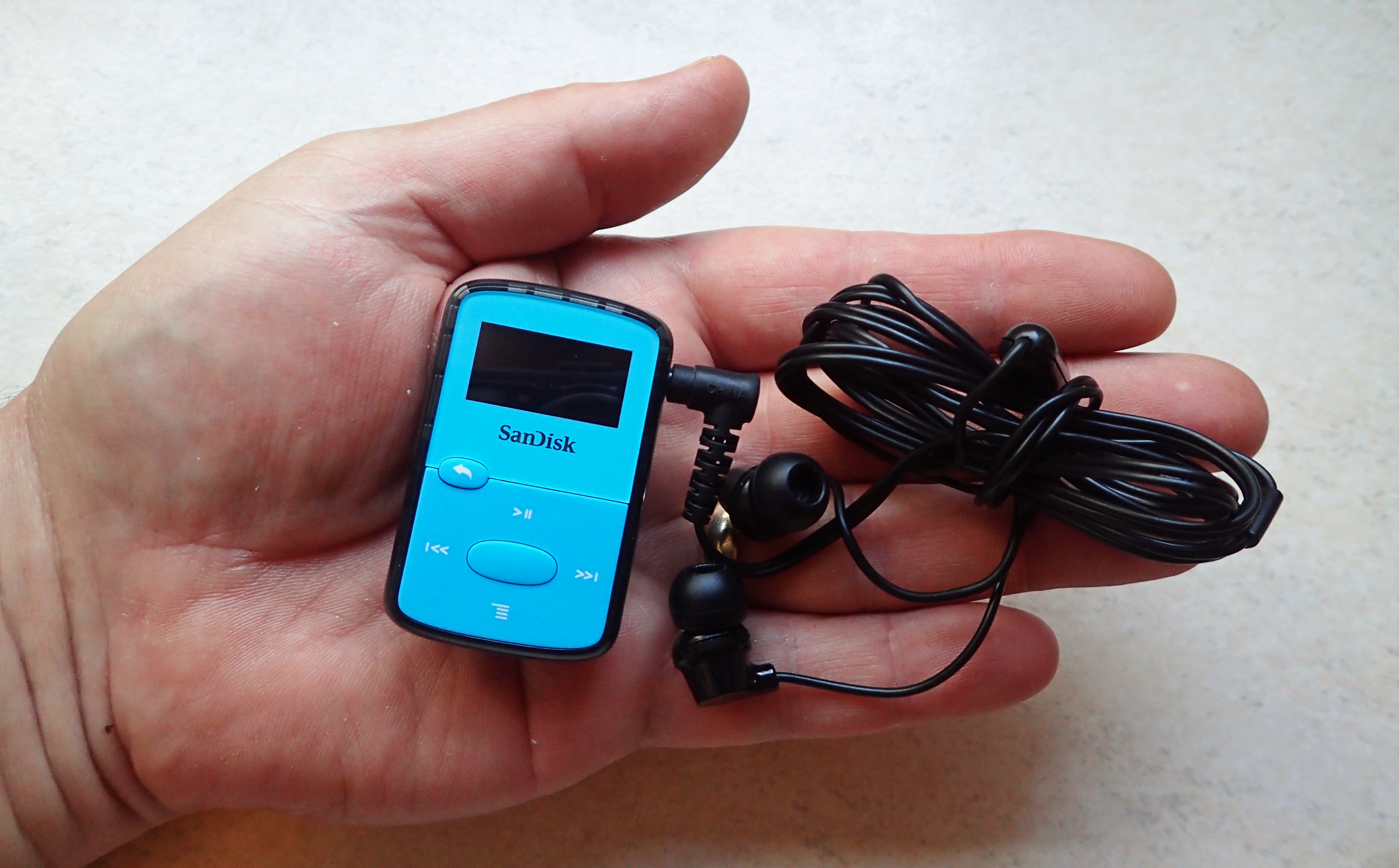
SanDisk Clip Jam MP3 player with JVC ear buds- total weight: 38g
 Three Points of the Compass