
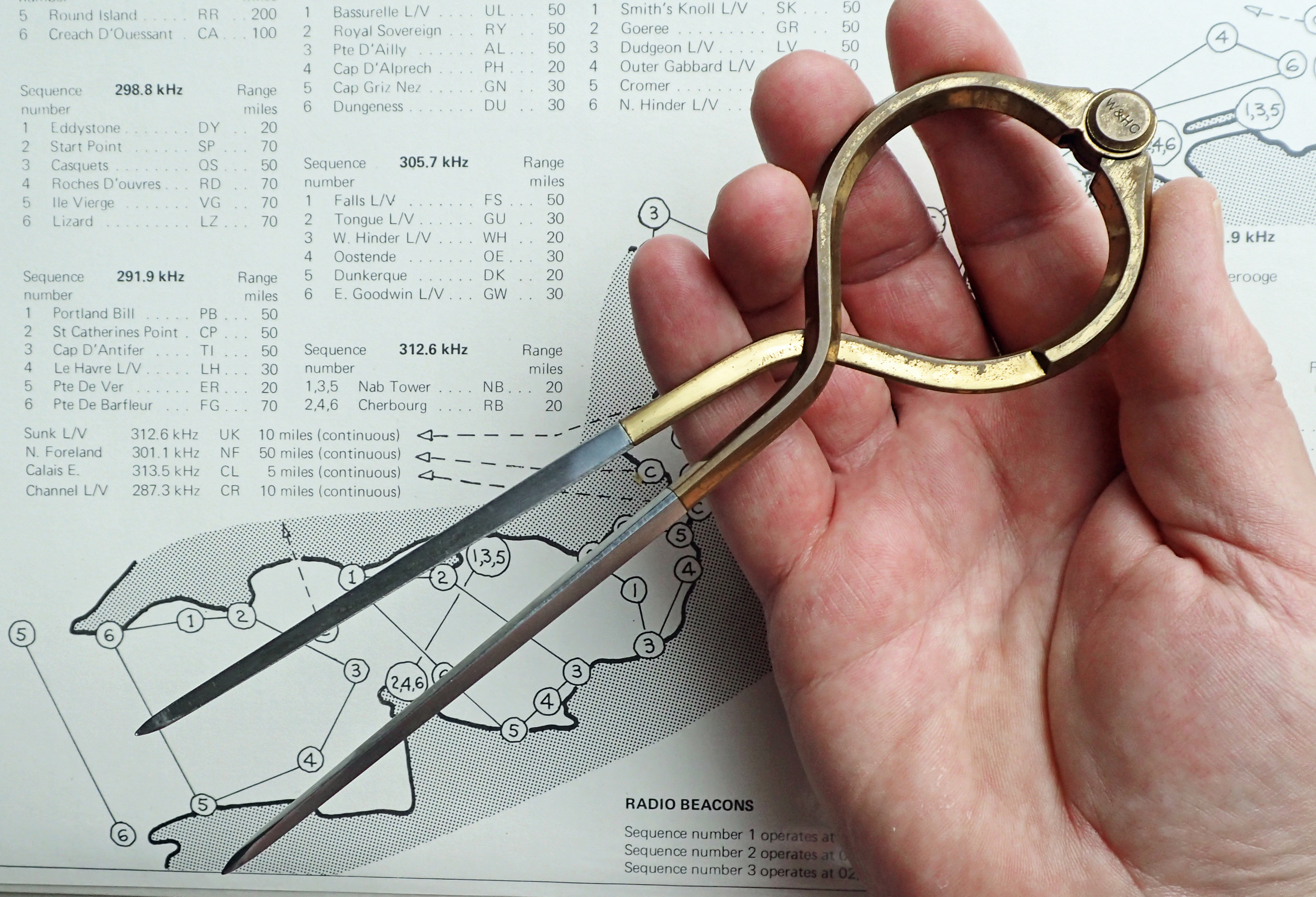
This month’s measure is a navigators divider, sometimes called divider calipers, made by W&HC. It is such a simple instrument, little description is required.
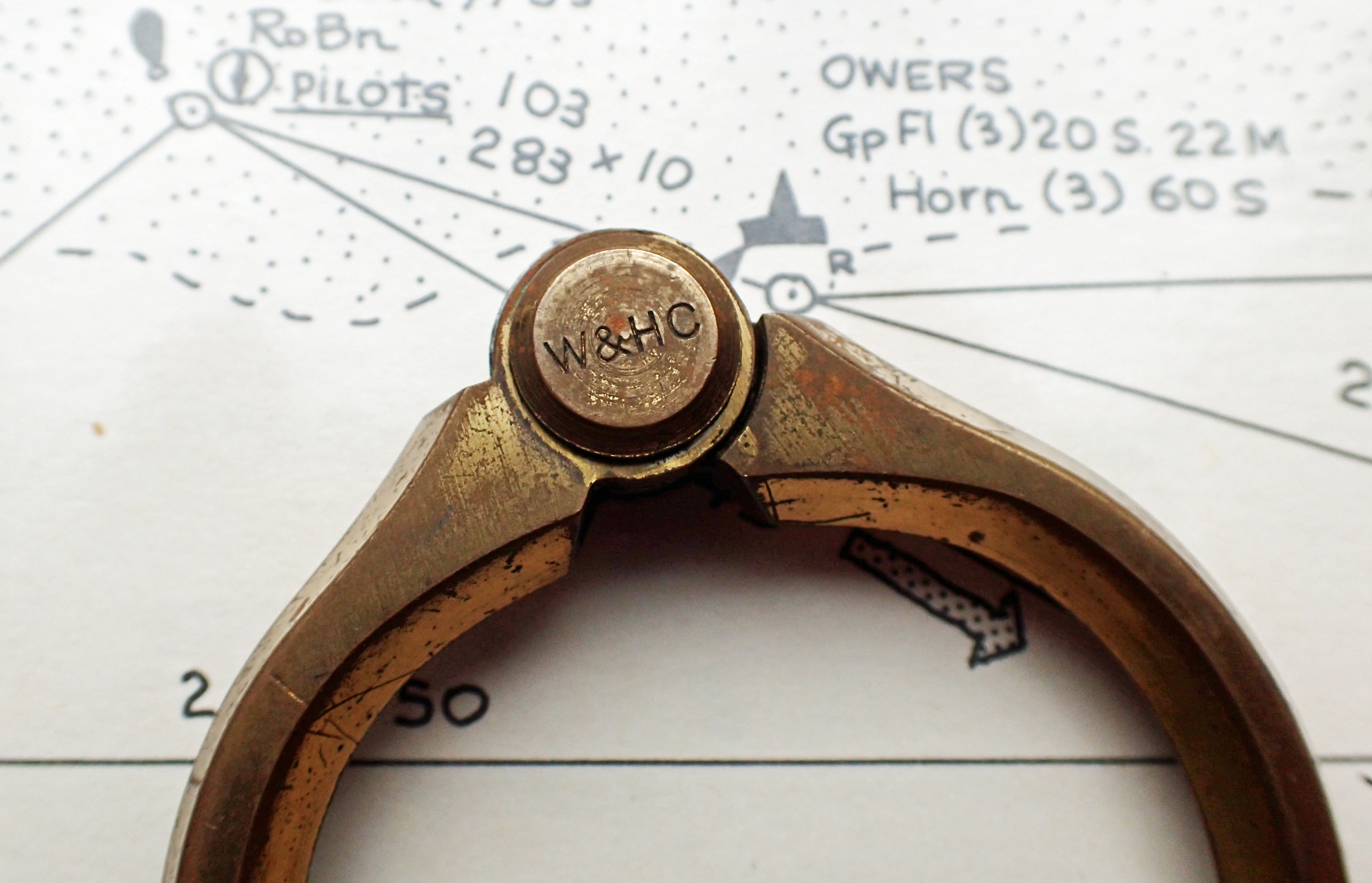
The two sharp stainless steel points are used for measuring distances on a nautical chart by transferring the gap between the pointed legs to or from a scale. Using the dividers and the latitude scale on a nautical chart, it is possible to measure a distance in nautical miles. The upper part of the legs and the hinge are made from solid brass in a semi-circular form. This shape enables the user to alter the gap distance using only one hand, hence this type being known as a ‘one hand divider’. The selected gap in the tips is maintained by friction at the pivot hinge, the large slotted screw can be tightened if necessary. The maximum width the calipers can be opened to is eight inches (203mm) but would normally be used at far less a division.
Navigation dividers come in various lengths. The English-made dividers shown here are eight inches long and have a brass head with 18/8 stainless steel legs. The first number- 18, refers to the amount of chromium present and the second represents the amount of nickel. So, the 300 series stainless steel on these calipers has 18% chromium and 8% nickel. The all metal construction means these are quite weighty at 87g.
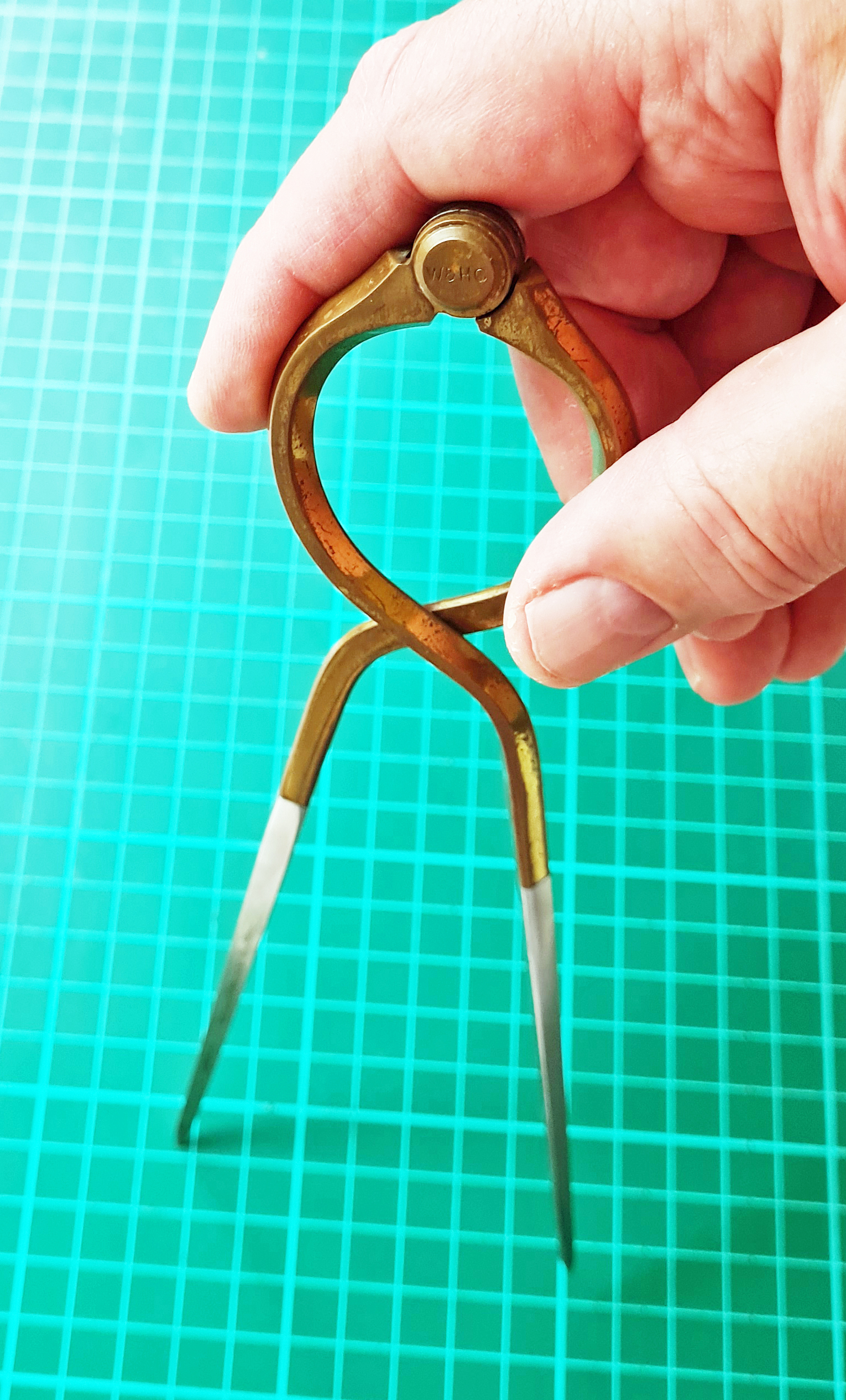
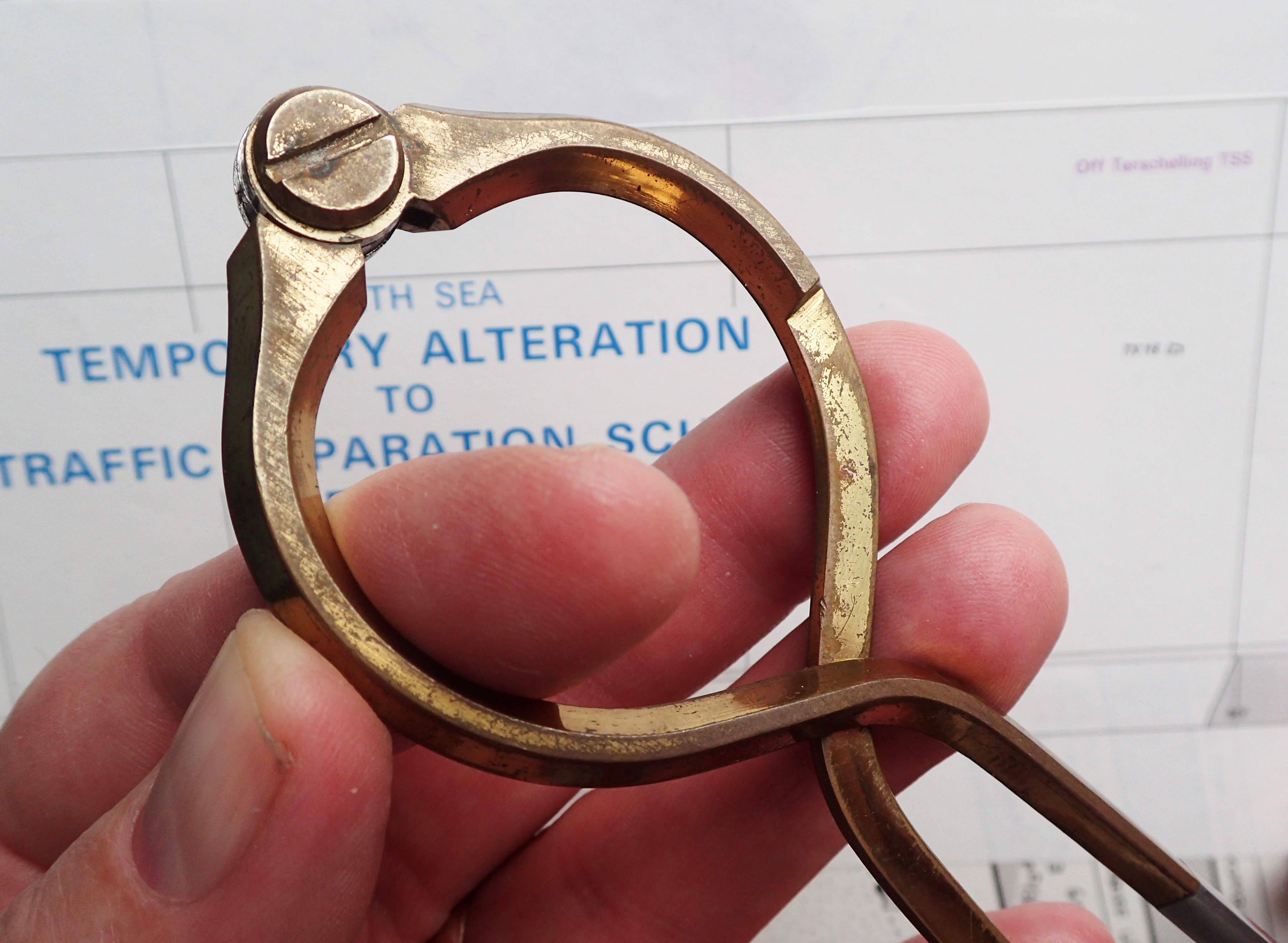
My pair of dividers have had a life. They are dinged, worn, scratched and tarnished. Testament to considerable use and far removed from the shiny brass dividers so frequently seen elsewhere. Yet such is their simplicity that they still work. No doubt GPS has decreased their usefulness in modern times but knowledge on the use of navigation dividers is still a requirement for those in charge of sea going vessels.
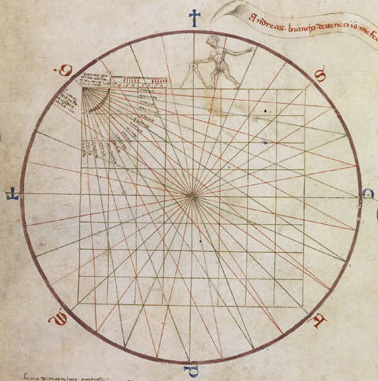
They are a simple tool and similar instruments have been used by navigators for centuries. I have included here an image from the Bianco World Map of 1436. Note that sailor and cartographer Andrea Bianco has included a cherub with easily recognised navigation divider on one of his drawings.
These dividers are quick and easy to ‘walk’ across a map or chart and surprisingly accurate. These were an essential tool for the sailor and my pair have a family connection. These were used by my uncle in the 1970s and ’80s in his role as Tug Master.
There is almost nothing I can add to this scant description and am frustrated in not being able to expand on the maker. I know nothing of W&HC and welcome any additional information.
Three Points of the Compass has looked at a few more Map Measurers in detail. Links to these can be found here.

 Three Points of the Compass
Hello there.
Perhaps I can help – albeit only a little – with your quest for information about W&HC. I happen to own two pairs of W&HC dividers, which I bought in the nineteen-seventies from a traditional marine chandlery in Poole, Dorset. I recall discussing the quality of the dividers with the owner of the chandlery (whose name was Harold Pipler) and he told me that W&HC was a family business – very much a “cottage industry” venture – and that the dividers were hand made by two elderly brothers in a small workshop at their home.
I can’t recall the names of “W and H” or where they lived, but as Mr Pipler tended to source his wares locally W&HC are likely to have been based in the west country, possibly in or close to a commercial port in Dorset or Hampshire. As that was half a century ago, I sadly feel it’s fairly unlikely that either of the brothers – who were elderly at the time – are still alive.
Like your relative, I too was a tug master (deep sea towing and salvage in my case) but I also skippered many other types of vessel, and in those days a pair of W&HC dividers was pretty much a standard item on almost every British ship’s chart table. So over a long period of very many years the two brothers must have produced thousands of their dividers.
Finally, a caveat for anyone who wishes to own a pair. You’ll see for sale on Ebay and elsewhere similar dividers with “W&HC” stamped on the pivot screw. Some of those examples are old and genuine W&HC products, but others are brand new and are made in the far east. The quality of the brass, stainless steel, and the general construction of the far eastern copies does not appear nearly as good as that of the genuine W&HC product. However, looking on the bright side, imitation is the sincerest form of flattery!
Hope this might be of some interest.
Kind regards,
Chris Bingham
(sea captain – ret’d).
LikeLiked by 1 person
Many thanks Chris for the helpful additional information on W&HC navigation dividers. Also the timely word on modern copies!
LikeLike
My W&HC dividers have ‘BRITSH MADE’ stamped on the slot side of the pivot, the side opposite where the W&HC initials appear. Does this assertion of genuineness indicate a modern fake?
LikeLike
Thanks for your question Clive. I so wish I could answer it! Genuinely British made, foreign made and British assembled, foreign homage, fake, who knows? I wish I could find out definitively
LikeLike
I have a pair – found them at a yard sale ($1) and cleaned them up. The slot side of the screw says ‘Made in England.’ They are very finely made (I’m a jeweler) — too nice to be an Asian knock off.
LikeLike
Nice find Jaime
LikeLike
Good evening
I worked for W&HC , the original Directors were Walter & Henry China (hence W&HC stamped on the screw head) one of the Diretors insisted on being called Jim he was married to a French lady, also a Director. Jim and his wife lived in Hockley Essex and the workshop was in his large back garden and backed onto Hockley woods, approx 8 people were employed to manufacture the chart dividers. I was employed to design and make jigs and tooling to automate as much of the workshop as possible leaving minimal hand finishing. I was there from 1976 to 1980, following automation we produced 30,000 pairs of dividers per year, they were sold all over the world ! we could not produce enough to satisfy demand. I can confirm they were made in England, if the stainless steel legs have 18/8 stainless steel stamped on them, I set up the tooling for this they would be dated from 1976 onwards. Another check to see if the dividers are genueine is you will find two beeswax and graphite impregnated plastic washers either side of the screw head joint, I also made the press tooling for this as well.
Various versions of dividers had been made for several years before I joined the company, they used to make drawing instrument sets and dividers, some were made from Nickel Silver which I think were for the Admirality. We were using basic machine tools, the lathe was started by pulling the belt on an overhead pulley, (even in 1976 the lathe was ancient), we had horizontal milling machines, polishing machines, a flypress and a few pillar drills and that was it. I recall an American company copied our dividers but used aluminium for the legs, which of course bent all to easily when droped, they became a competitor as the dividers were sold cheaply, at first glance they looked similar but on close inspection were far inferior, I have seen some advertised but the legs are always short where the points have been reground and the screw head is alway chewed up where the joint failed and become lose.
Unfortunately the Director Walter ( Jim China) passed away, from memory in the mid eighties and the company was eventually sold , I beleive the company and tooling was sold to a company in the North of the Uk , but that is all I know. Fond memories and a great company and people to work for, very old school where the staff took pride in their work. I still have some dividers and have repaired some recently, a true british made item, designed by skilled engineers and built to last!!
I hope you find this interesting.
LikeLike
Thanks for this Garry, fascinating stuff. You have really filled in the blanks
LikeLike
I just picked a pair of these dividers up at a local to me in South Wales, flea market. They’re in almost perfect condition and I paid the princely sum of £2 for them.
I just gave them a quick buff up on my polishing mops in the workshop and they look as good as new.
I love collecting quirky objects, especially brass and these jumped out at me in a box of clutter at the market.
I love them!
LikeLike
Result!
LikeLike