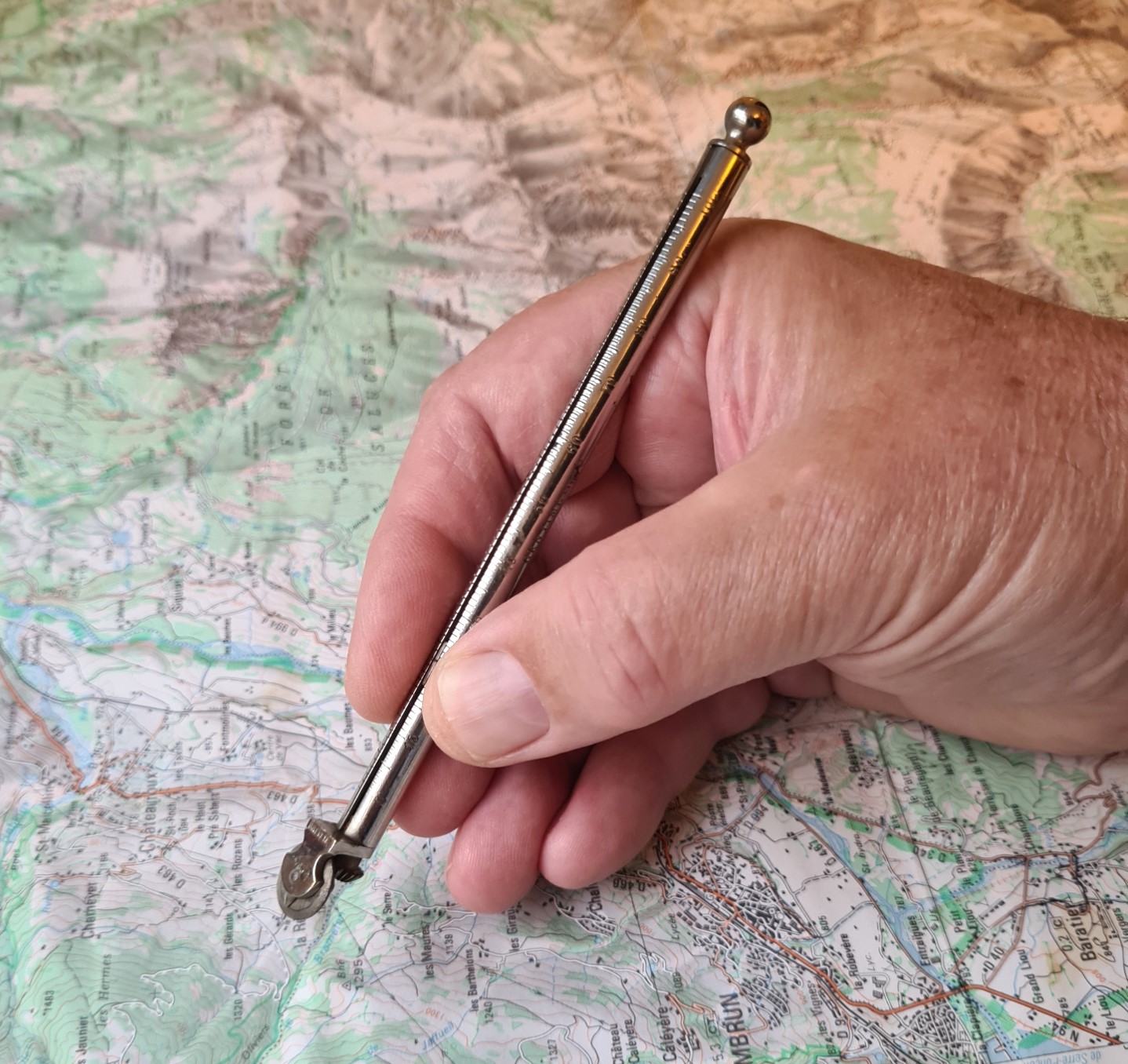
This month’s measure is a French made opisometer capable of measuring centimetres and lines on kilometre scale maps
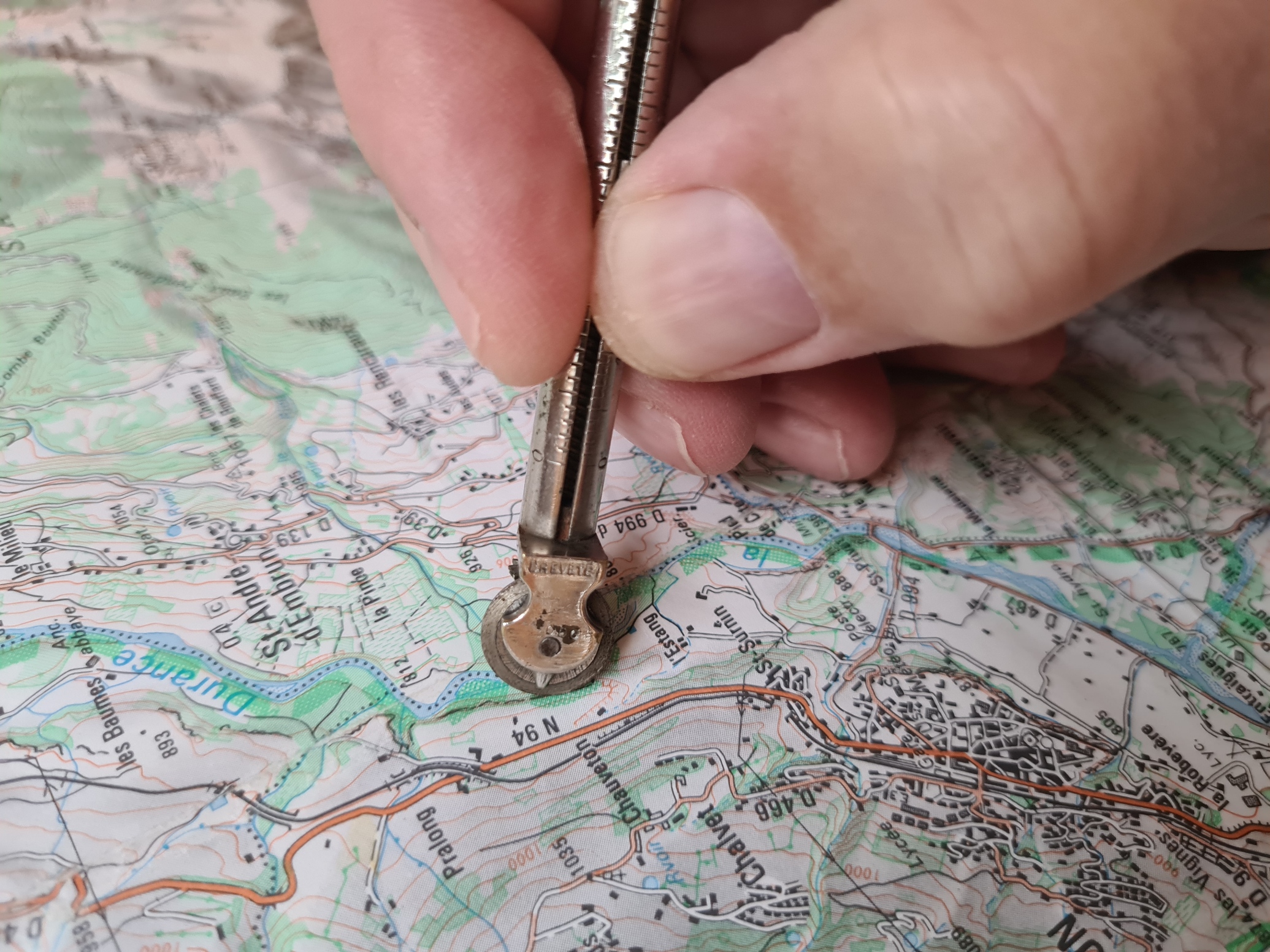
The opisometer is all-metal construction. It appears to be nickel plated steel, providing a shiny, corrosion and wear resistant finish. There is a small amount of age related wear on this example. Held in the hand like a pen, the small tracking wheel at the end is used to follow a line on a map. The instrument employs a worm gear, that meshes with a worm wheel at a 90 degree angle. This rotates a worm screw with spiral threads along its length similar to a screw. As the operator tracks a line on a map with the tracking wheel and turns the worm screw, the spiral thread within the body of the opisometer rotates, moving a small block up or down the shaft. This can be viewed through a slot in the side. The block has a line on it that indicates the distance moved on a map on two scales, one each side of the slot. Indicating kilometres above and centimetres below. The opisometer has a turned ball finial at the end, indicating French or Swiss manufacture though this instrument is from France.
I have looked at opisometers before, though none replicated this exact same operation or all-metal construction. Those opisometers that have previously featured have come from England, France and the U.S.A. Of these, the Mile-O-Graph, Radix and Roller Rule each had a similar, but different, distance indicating facility in the side of their main body.
- Map measure of the month: Elliott Brothers opisometer
- Map measure of the month- the Mile-O-Graph
- Map measure of the month: the Radix
- Map measure of the month: The Roller Rule- “The Pencil with a Brain”
- Map measure of the month: Société des Lunetiers Curvimeter
- Map measure of the month- Stanford’s opisometer
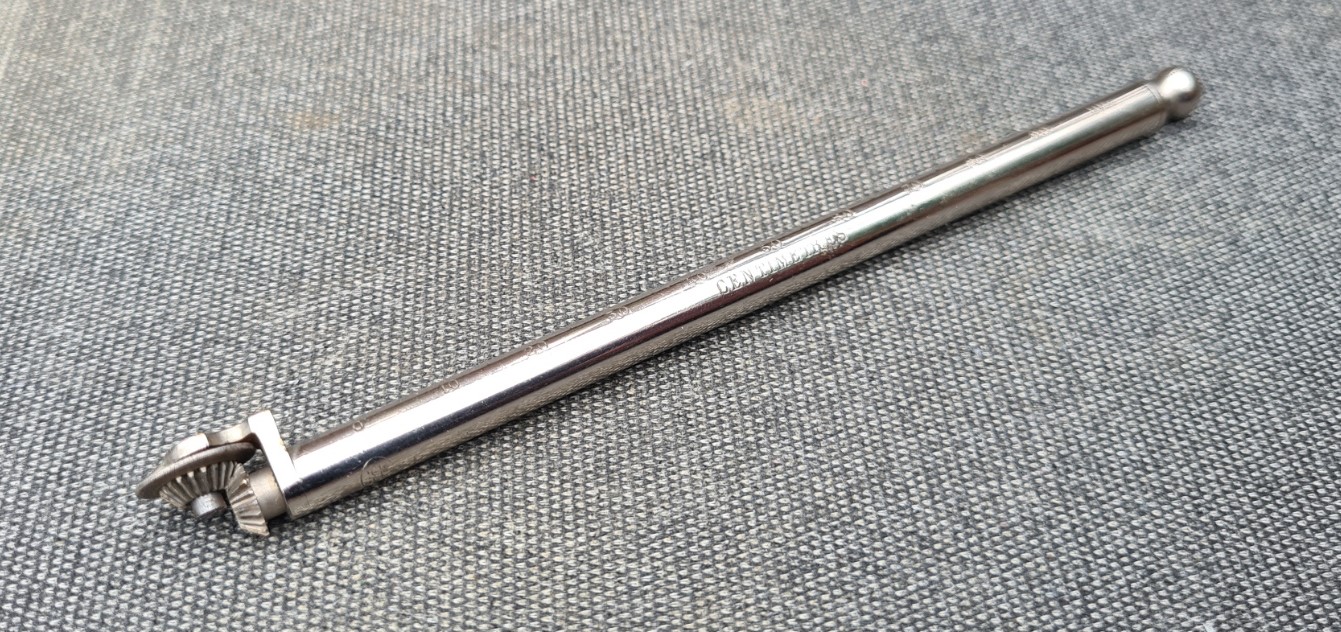
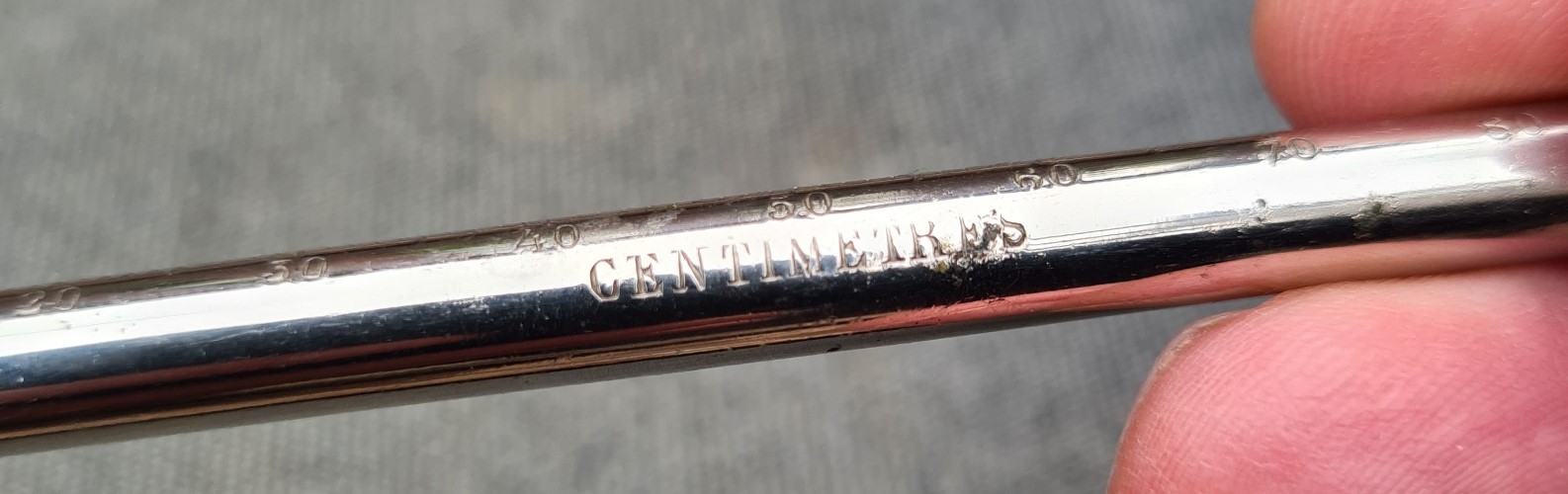
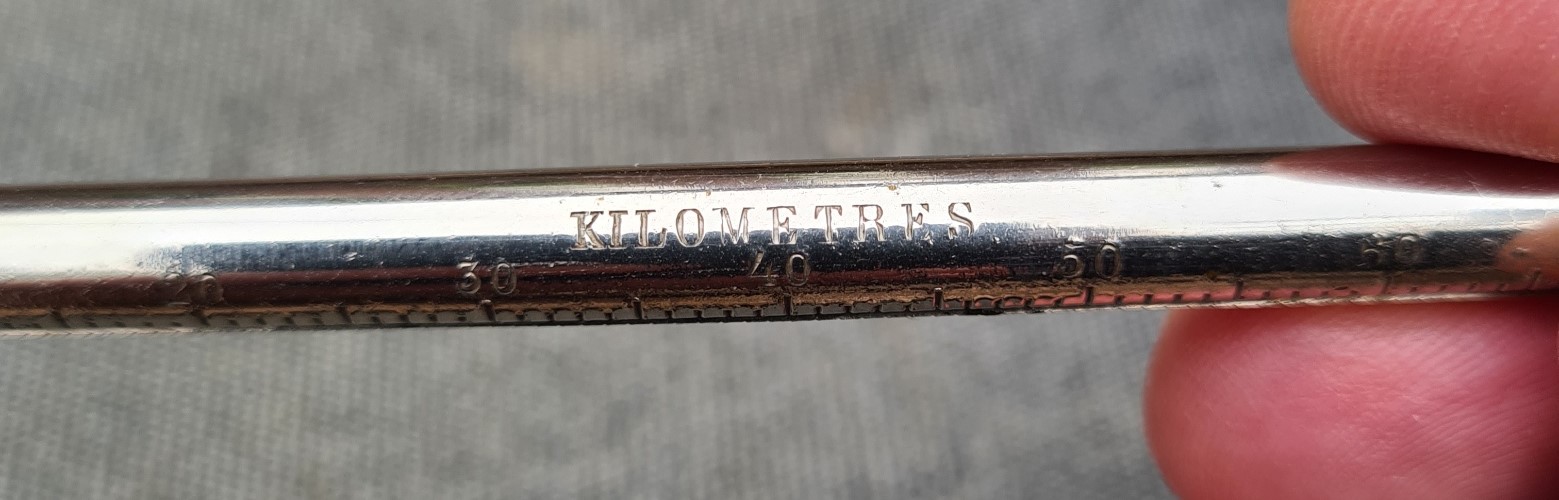
Length is 144mm and the main body of the instrument is 7.2mm diameter. It weighs 34.3g. Despite having a smooth body it can be easily held while using. It has a firm and fairly stiff movement. The tracking wheel has the faintest of serrations that will provide a little grip and reduce skidding on a map. The operation is smooth enough to move freely when tracking a line on a map. For such a small and simple instrument it can measure quite a distance- Up to 100 centimetres, with marked increments of 0, 10, 20, 30, 40, 50, 60, 70, 80, 100, with one centimetre inter-increments. A kilometre scale is indicated on the other side of the open slot- Increments of 0, 10, 20, 30, 40, 50, 60, 70, 80 are shown, with one-tenth inter-increments also indicated.
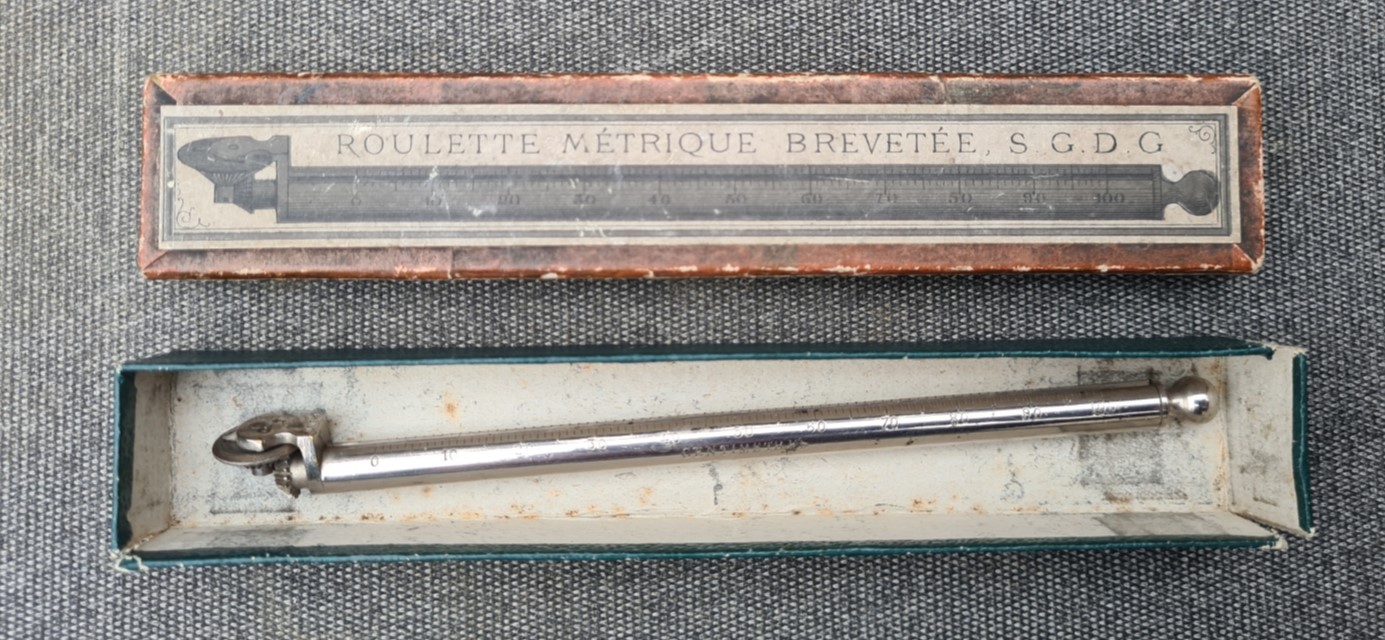
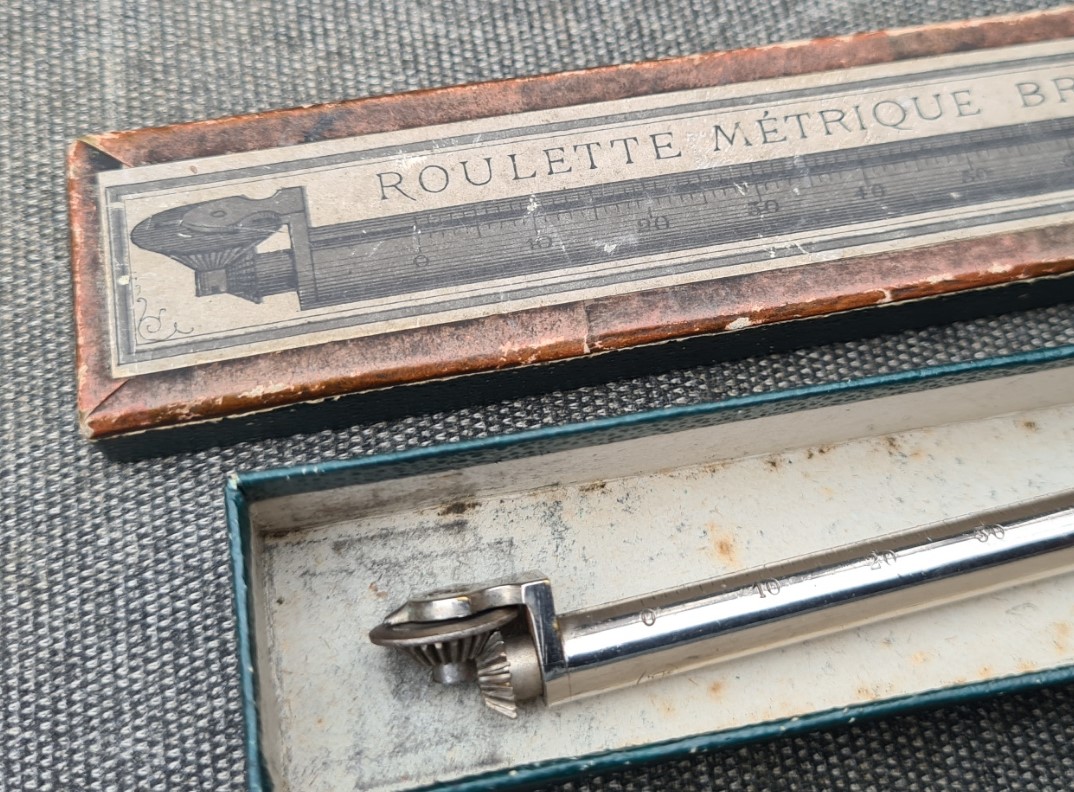
The opisometer was supplied in a two part card box with paper pasted over it. Perhaps unsurprising for such a simple to use instrument, no instructions are included, but the contents are described. The words “ROULETTE MÉTRIQUE BREVETÉE S.G.D.G” on the box lid refer to two aspects of the instrument contained within. It uses a small wheel to measure in the metric system, while “brevetée S.G.D.G” was a French type of patent system laid down by statute in 1791. 1800 and 1844 statutes updated this system and it was from 1844 that the S.G.D.G. inscription began to be added to most manufactured objects requiring it. The system was abandoned in 1968. The letters are an abbreviation of “Breveté Sans Garantie Du Gouvernement“ (patent without government guarantees). While an invention was supposed to be new, this was not checked. The ‘Law of 5 July 1844, First title, General Provisions’ demonstrates how useless such a designation is when it comes to a supposedly unique and accurate measuring instrument.
“Les brevets don’t la demande aura été régulièrement formée seront délivrés sans examen préalable, aux risques et périls des demandeurs, et sans garantie soit de la réalité, de la nouveauté ou du mérite de l’invention, soit de la fidélité ou de L’exactitude de la description.”
Translation:
‘Patents the application for which has been duly filed shall be granted without prior examination, at the sole risk of the patent seekers and without guarantee neither for the actual existence, the novelty or the value of the invention for the correctness or accuracy of the description.’

Our opisometer fell within the Class XII Instruments de précision division for new S.G.D.G. patents: “Poids et mesures, instruments de mathématiques, compteurs et procédés d’essai” (Weights and measures, mathematical instruments, counters and test methods). This gives us a rough outside date range of 1844-1968 for our measure, however this design is most likely to be of 19th or, at the latest, early 20th century construction. The word ‘BREVETÉ’ (patented) also appears on the instrument itself, just above the pointer and tracking wheel. The initials SGDG are also repeated here, though the S is extremely faint and the worn electroplating has rendered the other three letters almost illegible.
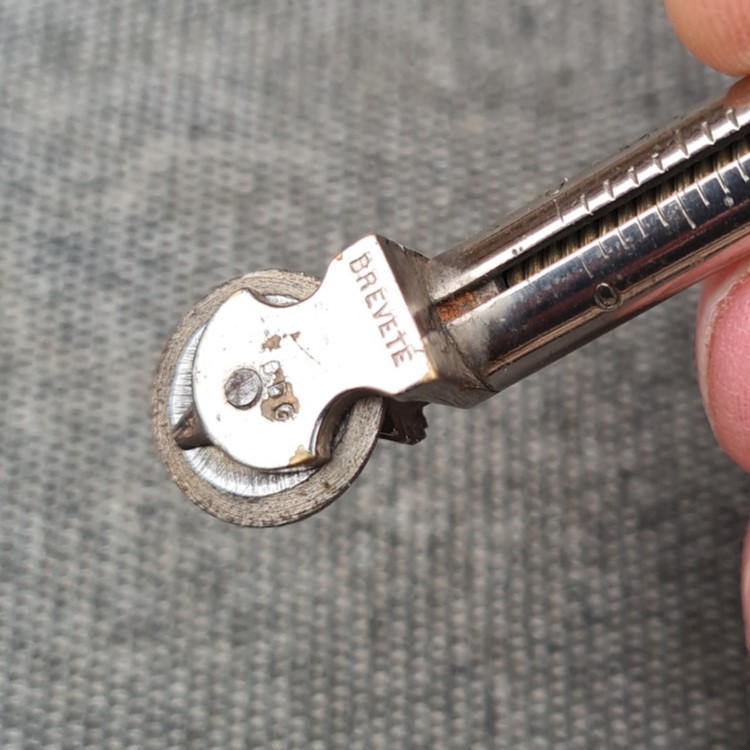
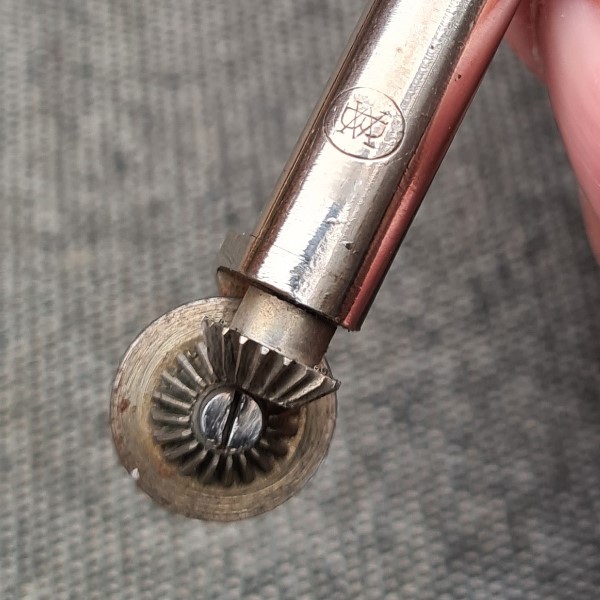
I do not know who manufactured or sold this little measure. There are what appears to be conjoined letters, that may be a manufacturer’s mark, on the back of the shaft of the instrument, but I do not know what these indicate. I welcome informed suggestions.
It is an interesting little opisometer and works remarkably well. Rolled along a line for one metre/100 centimetres, it registers 98.5 on it’s scale. Now almost certainly well over a hundred years old and an uncommon survivor, in theory, it could still be used to measure a line, but it is more one for the curious and collector today.
In addition to the opisometers listed above, Three Points of the Compass has looked at a few more Map Measurers in detail. Links to these can be found here.

 Three Points of the Compass
Fascinating and an interesting collector’s item. Not too inaccurate either
LikeLike
I agree Jim, I do prefer the dial type measures for some reason, but these little opisometers are an interesting alternative. Wish I could put a date and manufacturer to it though
LikeLiked by 1 person
Came across your blog while researching map-measurers for a “what is this thing?” post on Reddit. Have you ever encountered one with a watch-like strap? https://www.reddit.com/r/whatisthisthing/comments/1hd2y93/watchlike_object_with_concentric_circles_numbered/
I love your map measure of the month feature!
LikeLiked by 1 person
Looks like a pedometer to me Meredith, totally different instrument
LikeLike