
Oil the joints…
Having yet another tidy up of some drawers a few days ago, I came across a relic from my army days. I am pleased I hung on to this knife as it saw a lot of miles with me and a lot of sentiment is associated with it. I lost my previous issued knife and this replacement was issued to me in 1980, the same year it was manufactured, the date also being stamped on the side.
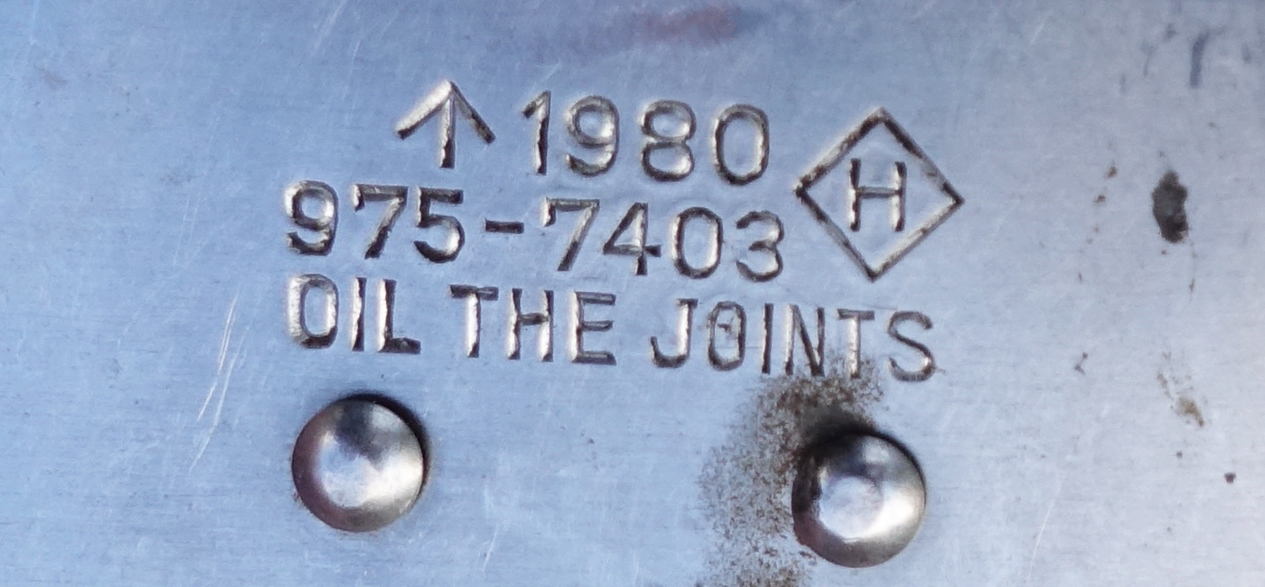
Crows foot, date of manufacture and part number were stamped on to the side of each knife issued
Three Points of the Compass was in the Royal Engineers, well known as the very finest of the British Army Corps. Whereas most British soldiers were issued with a simplified version of this knife, in my time, the version Engineers were issued also had a tough marlin spike on the opposite side to the blade.
There were actually four different knives issued to the British forces. Each had its own Nato Stock Number (NSN). These were:

Folding heavy duty sheepsfoot non-locking blade
- NSN 5110-99-301-0301 (with locking blade and can opener)
- NSN 5110-99-794-0491 (without can opener)
- NSN 7340-99-975-7402 (with can opener and no marlin spike)
- NSN 7340-99-975-7403 (with can opener and marlin spike)
As you can see, my example is the final one on the list. Made in Sheffield of stainless steel, these ‘squaddy proof’ tools are incredibly tough pieces of kit. They had to be as they put up with a lot of punishment. The back spring to the blade is equally tough. No nail nick is built in to the blade, instead, the metal scales are shaped to permit a good grip of the back of the blade to open it. This is a 60mm blade and could hold an edge pretty well. I see that my knife still has a good edge though I cannot recall the last time I sharpened it. Probably a couple of decades ago.
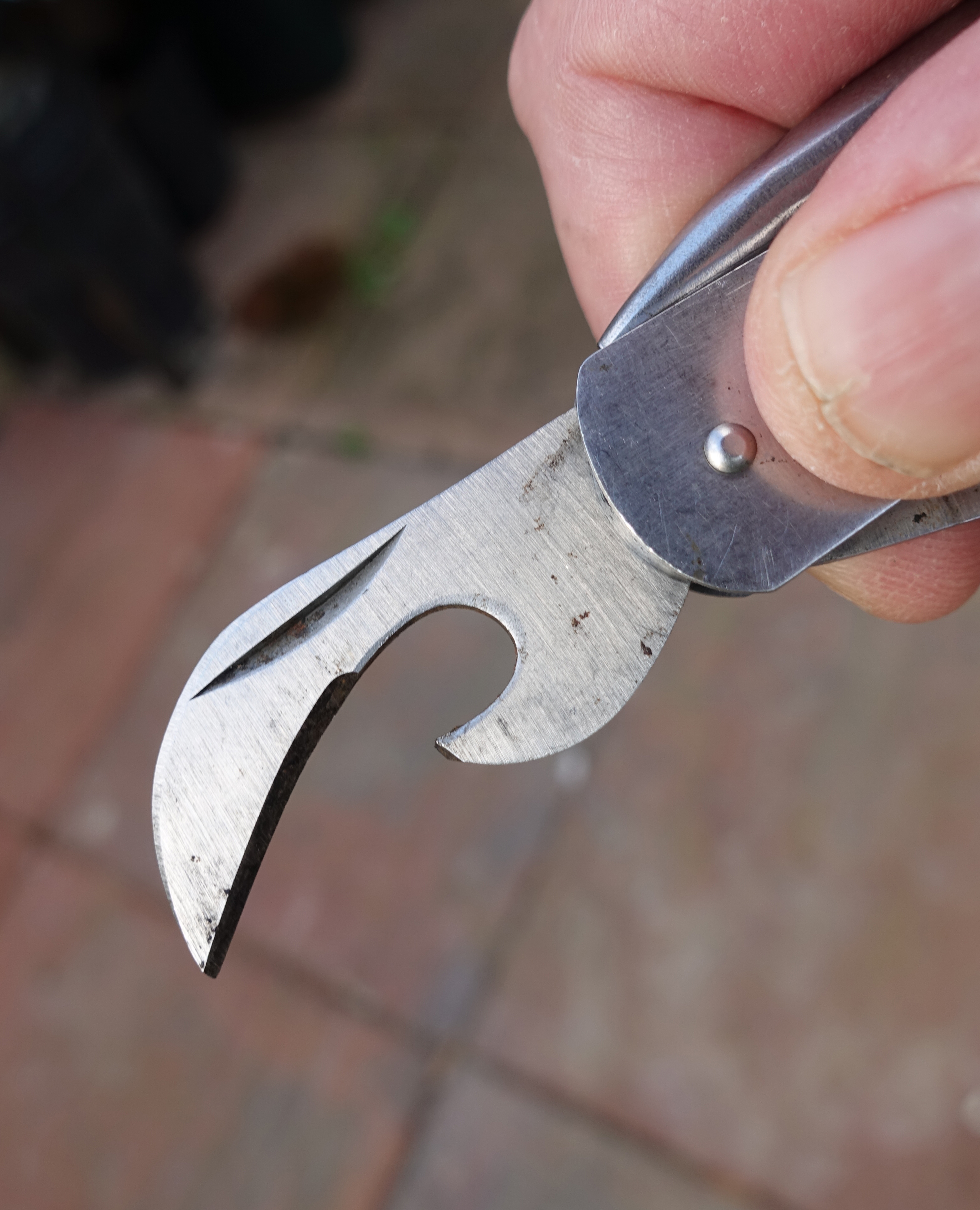
Huge and effective can opener
The can opener found on this knife has to be one of the largest found on any pocket multi-tool. Wickedly sharp, it’ll open any can put in front of it. A shackle is fitted to the opposite end to the can opener and would be attached to a lanyard.
Sappers carried the knife in the breast pocket and it was a chargeable offence to be caught without one. This was our EDC, or Every Day Carry, and was used for any task imaginable on a daily basis. On exercise they were indispensable- cutting para cord, batoning, opening tins and cutting up the awful, pale sausages and bacon grill found inside.
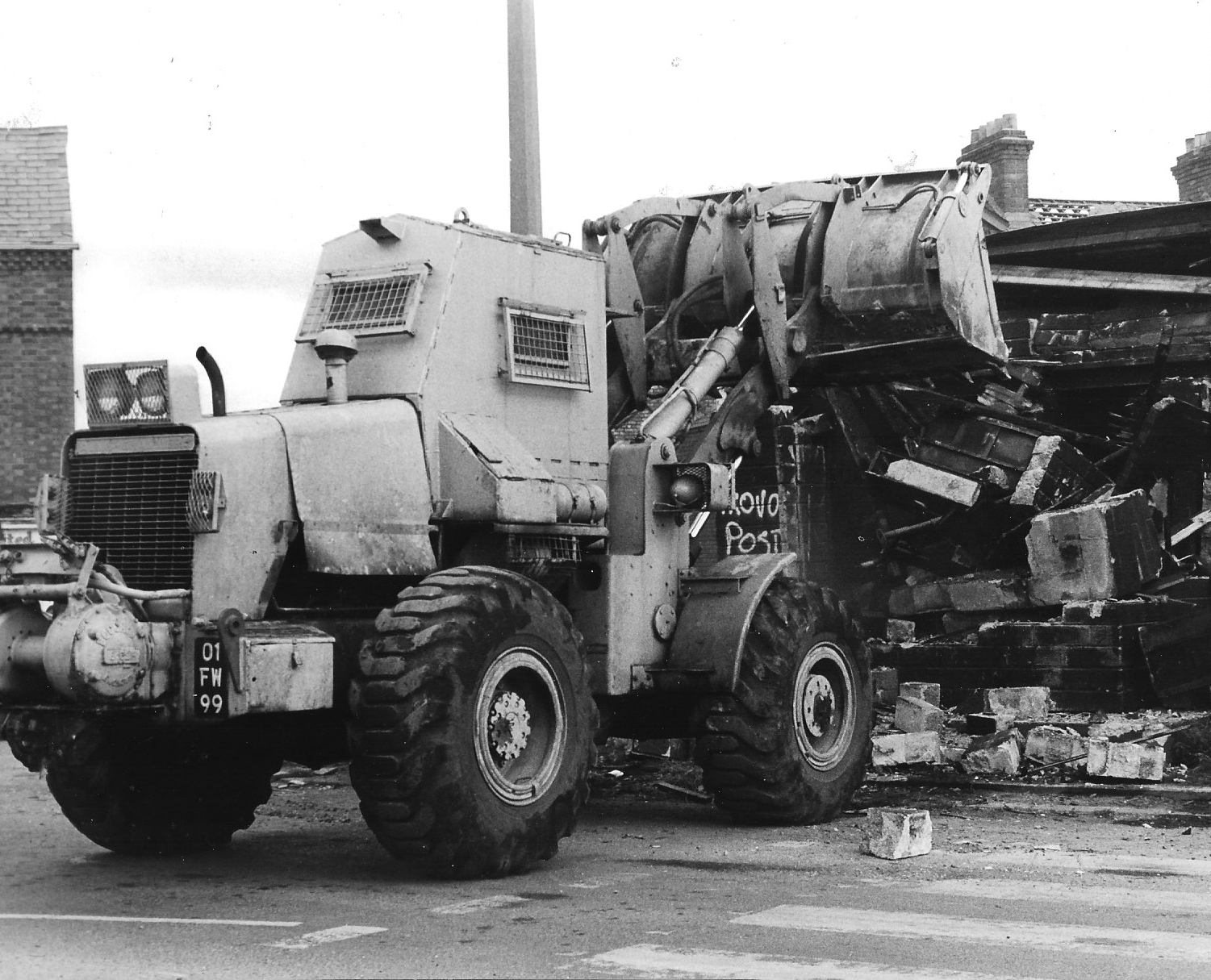
1984 and 1985 was spent in Northern Ireland during the Troubles. There was little room in the cramped cab of an armoured Allis Chalmers TL645 wheeled tractor. Occasionally an SMG could be thrown behind the seat while working, but invariably, all that we were armed with was our clasp knife. Though it was more frequently used when accessing the engine cowlings or adjusting the winch
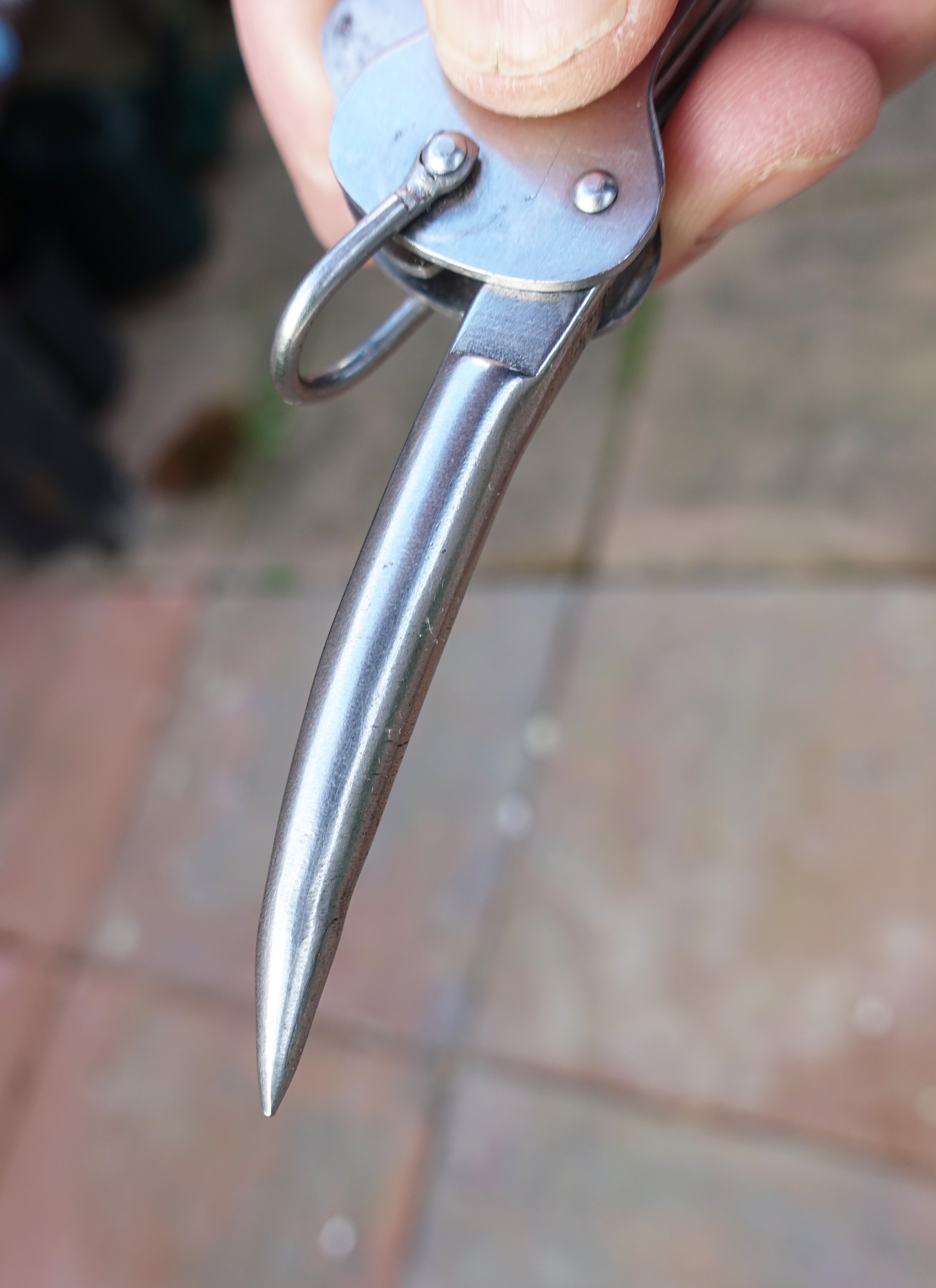
Nope, its not for getting stones out of hooves, the marlin spike is an essential tool for splicing ropework, loosening metal D shackles and knots in heavy cordage
The marlin spike was intended for rope work. Put to considerable use when in training in the late 1970s, less so when it came to later service. Though I do recall using it when engaged in improvised rafting or for loosening D shackles. This is not a lightweight knife coming in at 120g. While it went everywhere with me back then, I cannot see my ever resurrecting it as an EDC item, and will never take it backpacking. It is in need of a bit of a clean up now so I’ll probably just give it some attention, hone the blade, oil the joints (as per the instruction stamped on the side!) and once again consign it to a drawer somewhere.
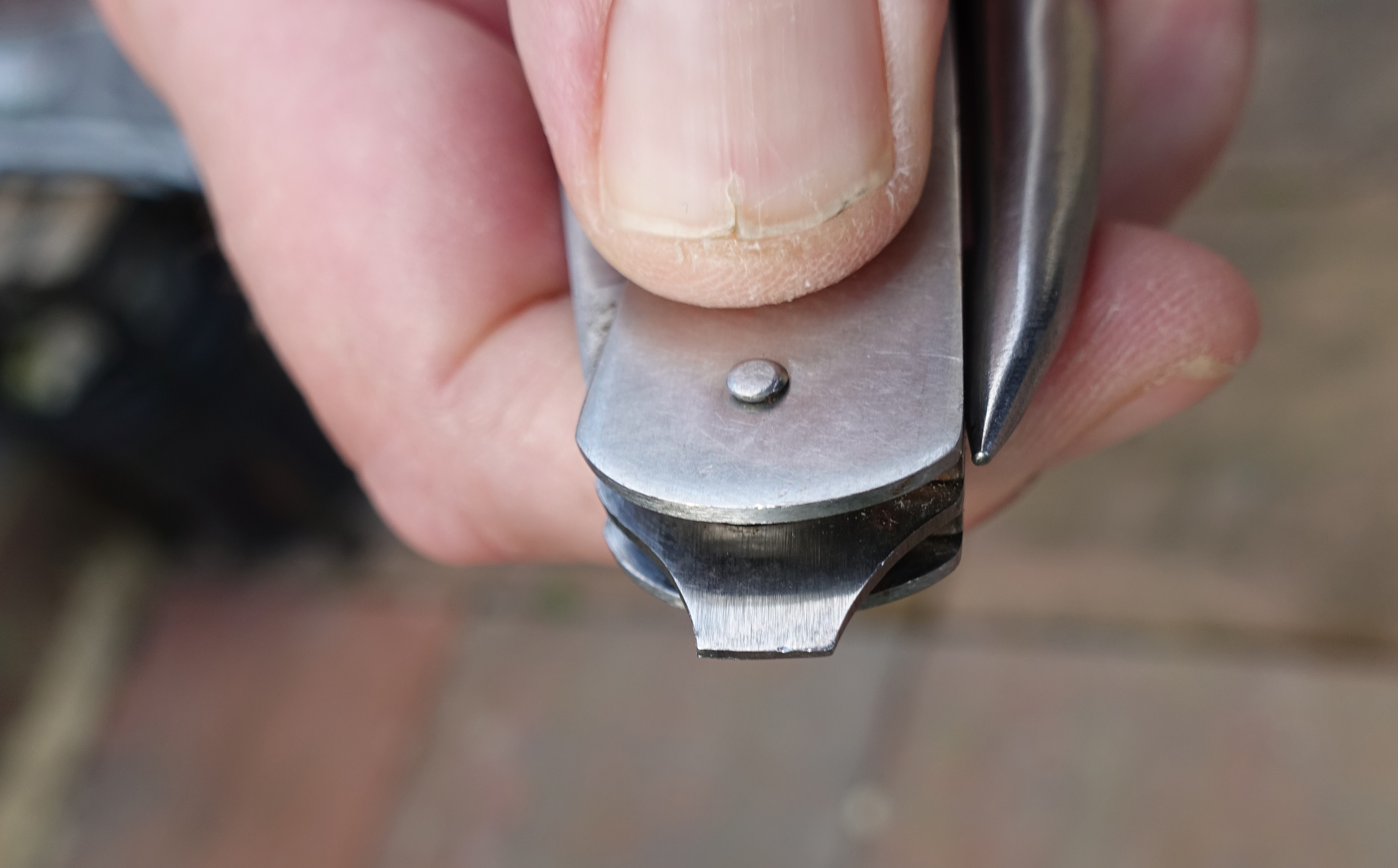
The wide flat screwdriver was used for anything from assisting in the stripping down of a 7.62 L1A1 Self Loading Rifle (SLR) to prising the lids off paint tins
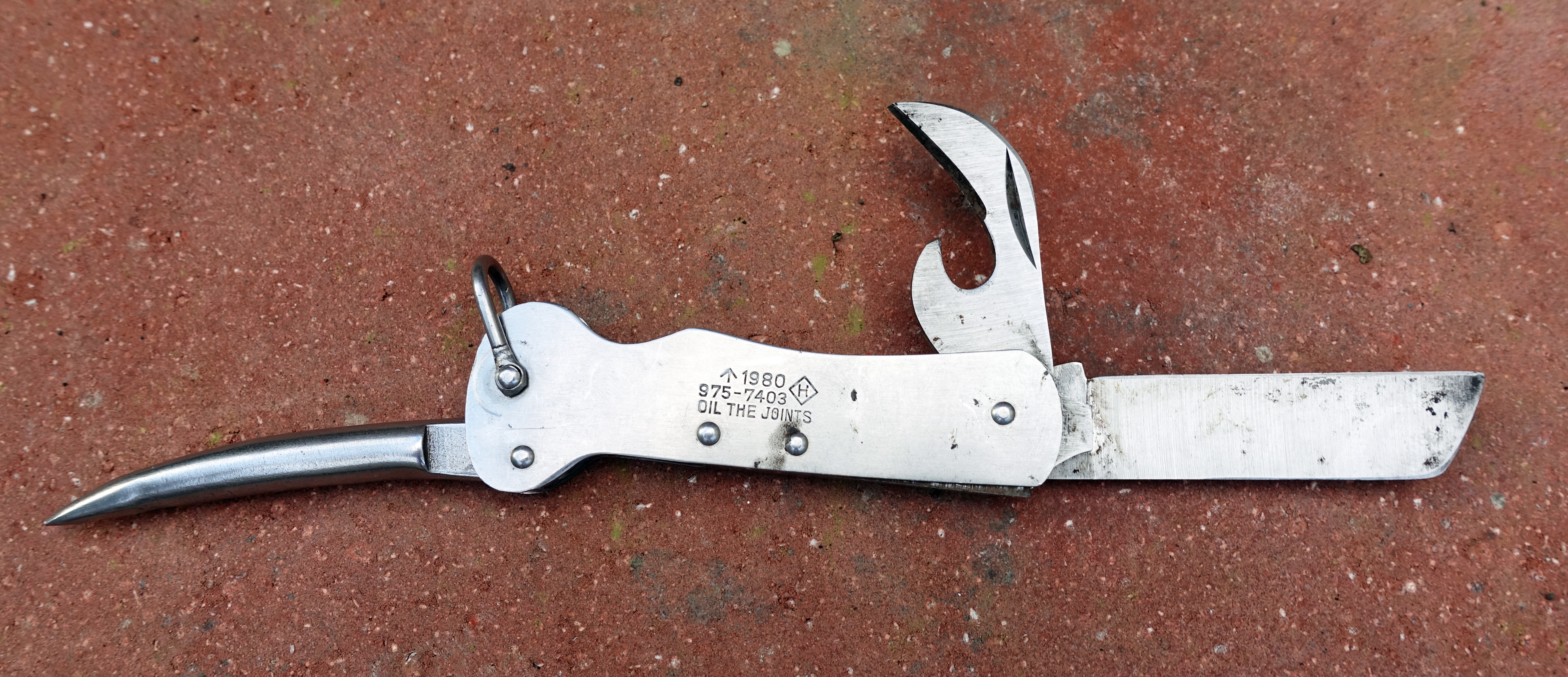
‘Oil the Joints’- A useful piece of kit- in its day
Three Points of the Compass has looked at quite a few knives and multi-tools that may, or may not, be suitable for backpacking, day treks or Every Day Carry. Links to these can be found here.


i have the locking blade/can opener army knife,can you explain to me what UTD stands for,this is printed on the blade,thanks.
LikeLike
Hi Neil, sorry, I can’t help you with your blade markings. My old army companion has no blade inscription beyond ‘Stainless Steel’. It is also a non-locking sheeps foot blade. My simple resin scaled army knife passed on to me that my dad had during his military service does have a locking clip point blade, but that also has no blade marking beyond the maker- ‘Venture H.M.Slater Sheffield’
LikeLike
I admit I did not know what a marlin spike was for. Well, now I know, so that’s good!
LikeLike
Yep, I used the marlin spike on my army knife a little during my service for rope/cordage splicing and lashings etc during improvised rafting etc. Mostly used for loosening obstinate D shackles though
LikeLike
The obvious follow-up question is which tool DO you use for getting horses out of boy scouts’ hooves? 🙂
LikeLiked by 1 person
As usual the British know how design ugly things. 😉
Probably the most horrible looking folding knife a soldier has ever seen.
LikeLiked by 1 person
Yep, when compared to the earlier bexoid folders, I have to agree
LikeLike
I’m restoring a NSN 5110-99-301-0301 and had to remove central rivet. When i did and removed the locking bar a small part fell out but i didn’t see where it came from. I have sat for hours trying to figure out where it goes to no avail. Would you have or have you ever seen a diagram of the simple workings? Thanks
LikeLike
My apologies Ian, I do not. Try one of the Reddit knife chats
LikeLike
Issued the same type of knife in ’83 (on a big green/gold(ish) lanyard), Operated the same Scooby at 33 in 87/88 🙂
LikeLike
A small world George! I seem to recall a lot of us fashioned our own lanyards out of paracord
LikeLike
Thank you for such an interesting read. I found your blog after searching the markings on the side of my knife. I had no idea it was an army issued knife.
I really don’t remember where I got it, but I’ve had it for at least 15 years. I came across it again after having a big sort out, and it was in one of my messy kitchen draws.
This one doesn’t have a marlin spike.
It makes so much sense that it’s military issued, as it’s an ugly knife. A basic, simple tool that is capable of doing what it’s built for. It’s quite heavy for it’s size and I can imagine it in someone’s breast pocket.
Anyway, I just wanted to say thank you for educating me on this knife. I wish they issued with markings to identify who it was issued to so I could return it to it’s owner. Never mind.
Thanks again.
LikeLike
Thanks, I soooo agree with the “ugly knife” comment. It’s utilitarian and “squaddie proof”
LikeLike